Middle School Game Development
From Player to Creator: A Complete Guide to Building Digital Worlds
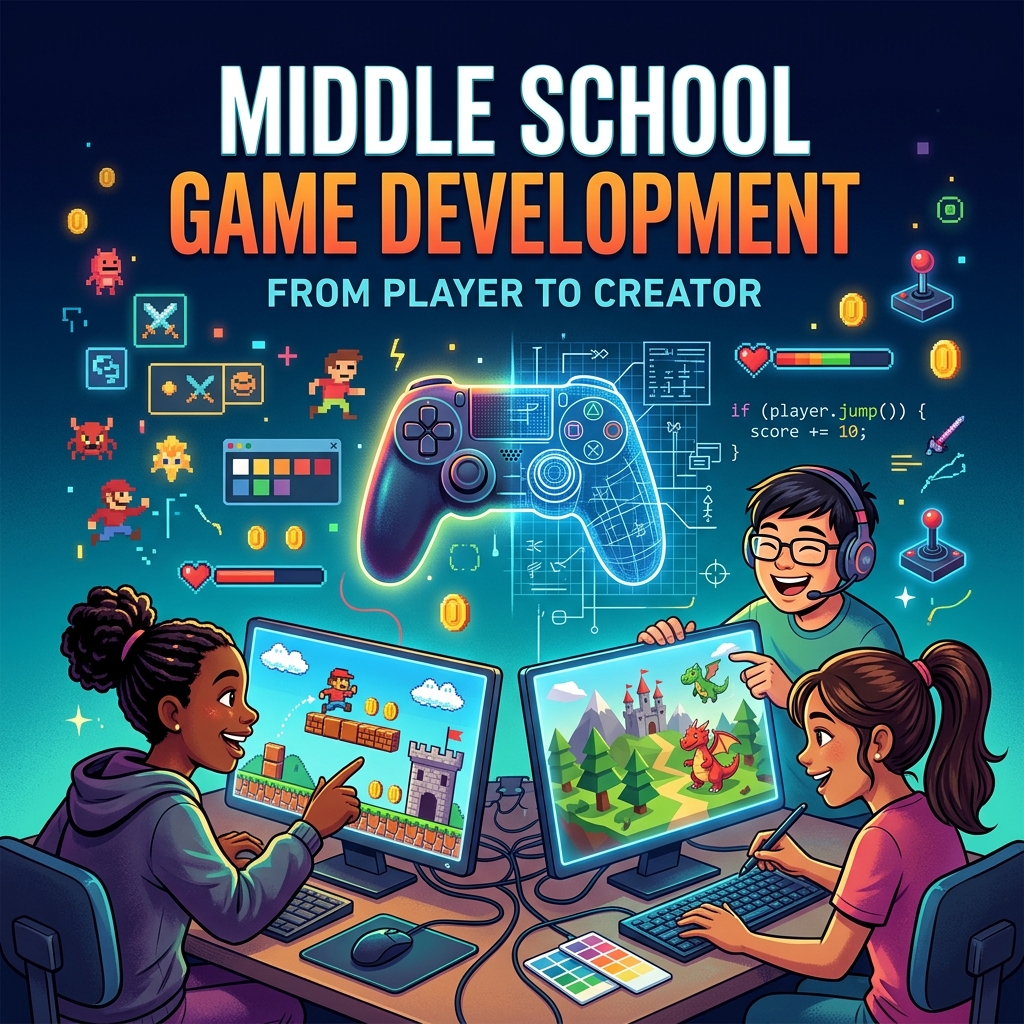
Playing video games is fun — but learning how to build them is a completely different adventure. This comprehensive guide teaches students to look at games not just as a player, but as a creator — covering history, design, art, code, and ethics.
What You'll Learn
A complete journey from understanding games to creating them.
History & Context
Explore how games evolved from ancient board games to modern digital worlds, and how computing technologies shaped the industry.
Game Design Documents
Learn to outline the full game development process — from concept and story design to rules, mechanics, and delivery.
Art & Visual Design
Dive into layout, composition, color theory, character design, level building, and animation fundamentals.
Programming Logic
Discover how to talk to computers, break actions into logical steps, control player movement, and use variables and constants.
Ethics & Law
Understand copyright, trademark, intellectual property, diversity, inclusivity, and responsible game design practices.
Hands-On Labs
Every chapter includes a Key Takeaway, Chapter Review, and a hands-on Lab to reinforce concepts through practice.
Table of Contents
- How games have changed over time
- Different types of games you can create
- The teams behind digital worlds: designers, artists, programmers
- Developing a game from concept to delivery
- Writing engaging stories and creating rules
- Building a Game Design Document
- Layout, composition, and color theory
- Designing memorable characters
- Building levels and using animation
- Talking to computers with code
- Breaking actions into logical steps
- Player movement rules, variables, and constants
- Copyright, trademark, and intellectual property
- Diversity, inclusivity, and player responsibility
- Acceptable security practices for game releases
Look Inside
From Chapter 1: The World of Game Development — Section 1.1
A Brief History of Games
Have you ever wondered how your favorite games came to be? Long before we had glowing screens, mechanical keyboards, and wireless controllers, people spent their time playing non-digital games. Think about ancient games like Chess or Mancala, or modern board games, dice, and card games. Exploring these non-digital games is incredibly important for game developers. Why? Because underneath all the flashy graphics of a modern video game, the core ideas are exactly the same. Non-digital games teach us the basics of rules, turn-taking, competition, cooperation, and how to create a challenge that is actually fun to overcome.
Early video games in the 1970s, like Pong, were incredibly simple — often just a few white pixels bouncing around a black screen. This was because early computers were very large and not very powerful. However, as computing technology advanced, so did the games. Developers learned to pack more memory and faster processors into smaller machines. By understanding the history of computing technologies that impact the game development industry, we can see how every new invention — from the first home consoles with chunky cartridges to modern smartphones that fit in your pocket — has given game creators new ways to tell stories and entertain players.
— Excerpt from Middle School Game Development, Chapter 1, Section 1.1: A Brief History of Games
Get Your Copy Today
Choose the format that works best for your classroom or home.
Digital eBook
Instant download — perfect for tablets, smartboards, and digital classrooms.
Add to CartPrint Edition
Full-color paperback — ideal for classrooms, libraries, and at-home learning.
Add to CartClassroom Bundle
20 print copies + 1 digital teacher's license. Contact us for district pricing.
Add to CartReady to go from player to creator?
Give your middle school students the complete toolkit to understand, design, and build digital games.