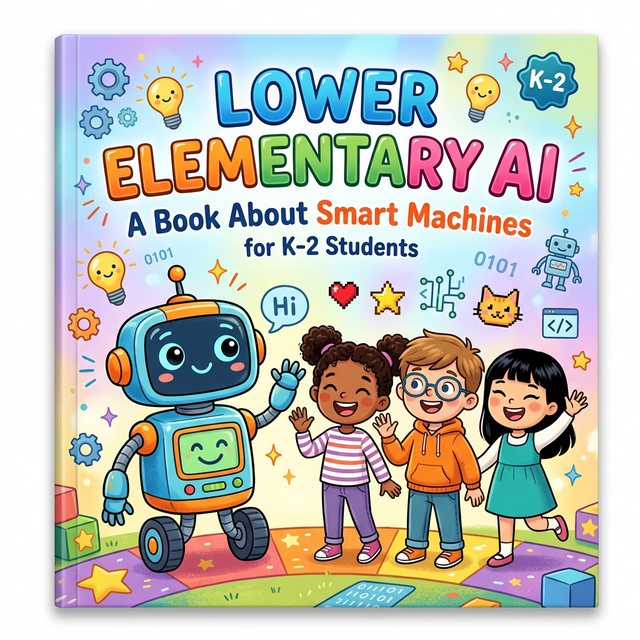
Lower Elementary AI
A Book About Smart Machines for K-2 Students
Break down complex computer science concepts into fun, relatable, and bite-sized lessons. Through vibrant illustrations, hands-on activities, and engaging short stories, students discover that robots use math, patterns, and instructions — not magic!
Why Educators Love This Book
Designed from the ground up for the youngest learners, with pedagogy that actually works.
Standards-Aligned
Integrates with ISTE, CSTA, AILit Framework, and AI4K12 standards for high-quality foundational learning.
Goal-Oriented
Each chapter begins with clear SMART goals to guide student learning and measurement.
Interactive Activities
Guided classroom games like "Pixel Mystery Art," "Tic-Tac-Toe Tournaments," and "The Fairness Cookie Challenge."
Engaging Short Stories
End-of-chapter stories featuring Bip, Chef-Bot, and Fair-Bot bring technical concepts to life.
Built-in Assessments
"Check for Understanding" pages help educators gauge student comprehension at the end of each chapter.
Comprehensive Glossary
Clear, age-appropriate definitions for vocabulary like Algorithm, Data, Pixels, and Common Sense.
Table of Contents
- Section 1.1: Pictures Are Made of Numbers
- Section 1.2: Listening and Speaking Clearly
- Section 2.1: Maps for Thinking (Algorithms)
- Section 2.2: Learning from Examples (Data)
- Section 3.1: Fairness and Sharing
- Section 3.2: AI Helps Us Do Good
Look Inside
From Chapter 1: How Robots See and Talk — Section 1.1
Pictures Are Made of Numbers
When you look at a picture on a tablet, you see colors, shapes, and maybe even your favorite character. You see smiles, trees, pets, and people. But a robot does not see the way you do. You have eyes and a brain that help you understand what you are looking at. A robot has a camera, but it does not truly "see" a dog or a tree. Instead, it sees something very different.
Every picture on a screen is made of tiny dots called pixels. A pixel is a very small square. If you could zoom in very close to your screen, you would see that the picture is really made of many tiny squares lined up in rows and columns. Each of those squares has a number. The number tells the computer how bright or colorful that square should be. Some numbers make a square dark. Some numbers make it bright. Some numbers make it red, blue, green, or another color.
When all the little squares are placed together, they form a picture. To you, it looks like a smiling face. To a robot, it is a big grid of numbers. The robot stores that picture as a list of numbers arranged in rows and columns. That is how robots "see." They do not see with understanding. They see with math.
— Excerpt from Lower Elementary AI, Chapter 1, Section 1.1
Get Your Copy Today
Choose the format that works best for your classroom or home.
Paperback Edition
Full-color, durable 59-page paperback — ships in 3-5 business days
Buy NowReady to spark a love for AI?
Give your K-2 students the foundation they need to understand the smart machines shaping their world.